Blog
Concrete Demo and Removal: What Hampton Roads Homeowners Should Know
That cracked, crumbling, or outdated concrete on your property is more than just an eyesore. It can pose serious safety hazards, drag down your curb appeal, and even affect your home's overall value. If you're a Hampton Roads homeowner considering a renovation or yard upgrade, understanding the basics of concrete demo and removal is an essential first step before any new project can begin.
The good news is that you don't need to be a contractor to make informed decisions about this process. Whether you're dealing with an old driveway, a deteriorating patio, or a broken sidewalk, knowing what to expect can save you time, money, and unnecessary stress.
In this guide, we've put together a clear, beginner-friendly list of everything Hampton Roads homeowners should know before tackling concrete demo and removal. From understanding the scope of the job to hiring the right professionals for your local area, you'll walk away with the confidence to move your project forward the right way. Let's break it down, step by step.
What Concrete Demo and Removal Actually Involves
Concrete demo and removal is a structured, multi-step process that requires planning, precision equipment, and proper disposal logistics. Understanding what professionals actually do on-site helps homeowners and businesses set realistic expectations before any work begins.
1. Site Assessment Comes First
Before a single piece of equipment is mobilized, a qualified professional evaluates the project conditions. This includes measuring slab thickness, identifying whether the concrete contains plain material or is reinforced with rebar or wire mesh, and confirming how accessible the site is for machinery and haul trucks. Utility lines running beneath or adjacent to a slab must be located and documented before breaking begins. This upfront evaluation directly determines which tools, techniques, and safety measures will be applied throughout the job.
2. Saw-Cutting Scores the Slab
Large concrete surfaces are not broken all at once. Diamond-blade saws cut controlled lines across the slab, dividing it into manageable sections. This scoring step prevents unintended cracking in adjacent driveways, foundations, or sidewalks and allows crews to work with precision around structures or utility lines that must remain undisturbed.
3. Jackhammering and Hydraulic Breaking Reduce the Sections
Once scored, each section is broken into smaller rubble using handheld jackhammers or hydraulic breakers mounted on excavators. Rebar-reinforced concrete requires an additional step; bolt cutters or torch cutting separate embedded steel from the concrete rubble before loading.
4. Debris Is Loaded and Hauled Off-Site
All broken material is loaded into haul vehicles and transported to a disposal or recycling facility. Full-service providers include this debris haul-off within the project scope, handling a waste stream that represents a significant portion of the materials tracked by the Construction and Demolition Waste Management Market.
5. A Growing Industry Reflects Real Demand
The U.S. demolition and wrecking market was valued at $9.8 billion in 2024 and is projected to reach $13.8 billion by 2032. That sustained growth reflects rising residential renovation activity, aging infrastructure, and increasing demand for professional concrete removal services in markets like Hampton Roads and across the broader mid-Atlantic corridor.
Common Residential Concrete Removal Projects
Residential concrete removal covers a wider range of project types than most homeowners expect, and knowing what each one involves helps you plan more effectively.
1. Driveway Removal Driveway demolition is one of the most frequently requested residential jobs in Hampton Roads. Older driveways develop surface spalling, deep cracking, and heaving caused by tree roots or repeated freeze-thaw cycles common in coastal Virginia winters. Once those conditions take hold, patching becomes a temporary fix at best. Full removal is the practical solution, and because driveways are often poured 6 inches thick or reinforced with rebar, the work requires heavy equipment and experienced operators.
2. Patio and Walkway Demo Patio and walkway removal is commonly paired with landscaping or outdoor living renovations. The challenge here is precision. A professional crew must remove the concrete cleanly without disturbing adjacent lawn, fencing, or buried irrigation lines. According to 2026 concrete removal pricing data, limited access through a side gate can add 20 to 50 percent to labor costs, making professional planning essential.
3. Garage Slab Removal Garage slabs are removed when homeowners convert the space, repair a foundation, or correct drainage problems beneath the slab. These slabs typically run 6 to 8 inches thick, and utility lines often run underneath, requiring locating services before any breaking begins.
4. Pool Deck and Apron Removal Pool deck removal is a growing request across Hampton Roads as aging backyard pools are resurfaced or removed entirely. Irregular shapes, plumbing cutouts, and tight staging areas make this a job that demands local expertise. Reviewing fair pricing benchmarks for concrete removal can help homeowners set realistic budget expectations.
5. Logistics Homeowners Underestimate Across every project type, a licensed local operator manages details most homeowners overlook: equipment staging on tight residential lots, notifying neighbors before heavy machinery arrives, and ensuring debris disposal meets local Virginia municipal requirements.
Commercial Concrete Removal Applications
Commercial concrete work operates at a different scale than residential projects, and the service categories reflect that complexity.
1. Parking Lot Demolition Parking lot tear-outs rank among the most equipment-intensive commercial concrete jobs. Slabs are typically thicker than residential flatwork, often reinforced with rebar or post-tensioned cables, and spread across large surface areas that must be broken, loaded, and hauled efficiently. Hydraulic breaker attachments and heavy excavators are standard on these jobs. Delays in breaking, processing, or removing debris directly affect business operations, so speed and coordination matter as much as raw capability.
2. Foundation Removal When commercial properties are being redeveloped, expanded, or reconfigured, existing foundations frequently need to come out entirely. This is not renovation-adjacent work; it is a core precondition of redevelopment. As Horst Excavating explains, demolition is a fundamental part of the project cycle for most non-greenfield commercial sites.
3. Interior Concrete Strip-Outs Warehouses, retail spaces, and manufacturing facilities often require removal of concrete flooring, equipment pads, or interior curbing without disturbing surrounding structural elements. This work demands precision techniques and equipment scaled to confined indoor environments.
4. Who Hires Commercial Demo Contractors Land developers, real estate firms, government agencies, and manufacturing companies are the primary buyers of commercial concrete removal services. These clients require documented compliance, responsible debris management, and contractor accountability from start to finish.
5. Single-Contractor Advantage Mr. Demo Pro handles structural, selective, and interior demolition across Hampton Roads, giving commercial clients one point of contact for permitting, execution, and debris haul-off rather than managing multiple specialty crews.
Key Factors That Affect Your Concrete Removal Cost
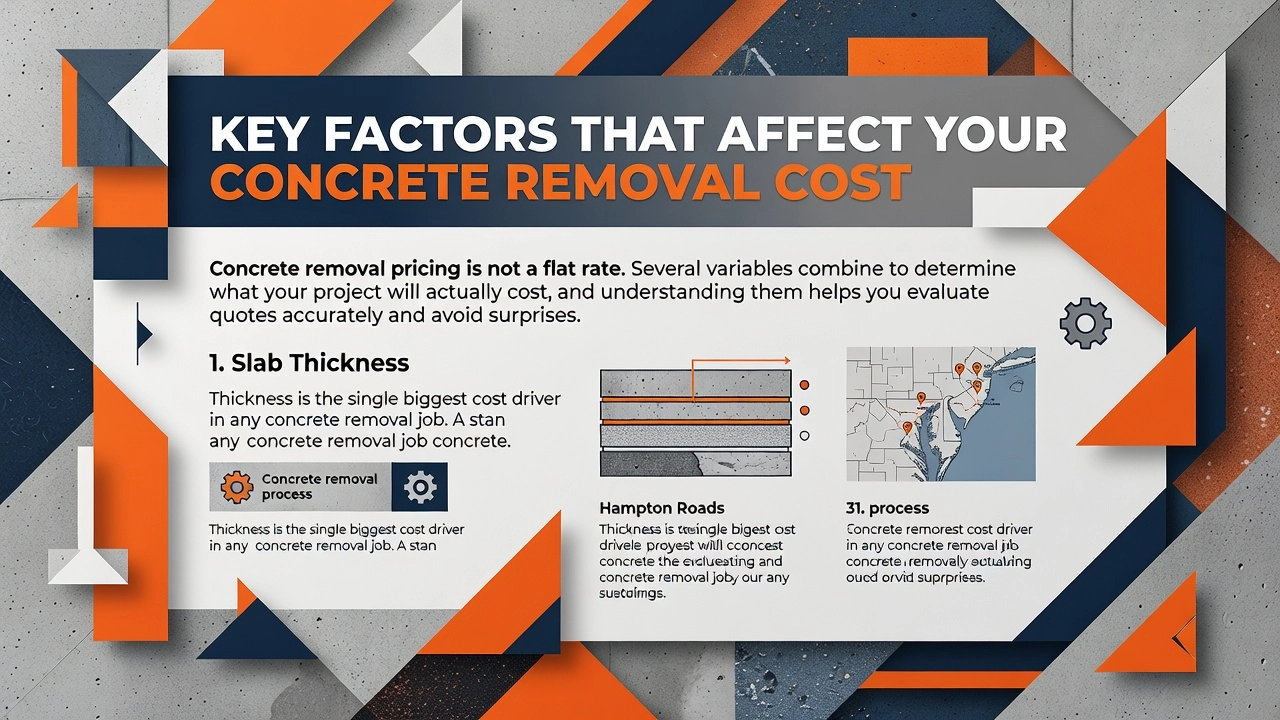
Concrete removal pricing is not a flat rate. Several variables combine to determine what your project will actually cost, and understanding them helps you evaluate quotes accurately and avoid surprises.
1. Slab Thickness Thickness is the single biggest cost driver in any concrete removal job. A standard 4-inch residential driveway requires far less labor, fewer jackhammer passes, and lighter debris loads than a 6-to-8-inch commercial slab or reinforced garage floor. According to current concrete removal cost data, slabs even one inch thicker than the baseline can roughly double the removal price due to increased mass and equipment time.
2. Reinforcement Type Plain concrete breaks apart quickly and loads cleanly into a haul-off truck. Slabs containing rebar or wire mesh require additional cutting time, metal extraction, and more careful handling throughout the process. Non-reinforced concrete typically runs $2 to $4 per square foot, while reinforced slabs push into the $4 to $7 range, per 2026 concrete removal pricing research.
3. Site Accessibility Tight side yards, sloped lots, and overhead obstructions limit which equipment can reach the work area. When heavy machinery cannot access the slab directly, crews rely on more manual labor, which increases both time and cost significantly.
4. Total Project Volume Debris tonnage scales with project size, and commercial contractor cost guides confirm that disposal fees follow accordingly. A small patio generates a fraction of the tonnage produced by a full driveway or parking lot tear-out.
5. Get a Free On-Site Estimate The most reliable way to account for all of these variables is a free, on-site assessment. Mr. Demo Pro (757-848-4559) evaluates thickness, reinforcement, access conditions, and debris volume before any work begins, giving you an accurate, upfront number with no guesswork.
Why DIY Concrete Removal Is Riskier Than It Looks
Many homeowners look at a concrete slab and see a straightforward weekend project. The reality is far more complicated, and understanding the specific risks before you start can save you from serious injury, unexpected costs, and legal headaches.
1. The weight alone makes this a professional-scale job. A single square foot of standard 4-inch concrete slab weighs approximately 50 pounds. That means a 200-square-foot backyard patio generates roughly 5 tons of broken material that still needs to be loaded, transported, and legally disposed of after the breaking work is done. A typical driveway or garage floor can push that figure to 15 tons or more. Most homeowners dramatically underestimate this reality until they are standing next to a pile of rubble with no viable plan to move it.
2. Rented demolition tools are genuinely dangerous without training. Jackhammers and demo saws are industrial-grade equipment designed for trained operators. Hidden rebar and steel mesh embedded in older slabs can catch a saw blade instantly, causing violent kickback that redirects the tool toward the operator. According to expert tips for concrete removal, professional crews use ground-penetrating radar and utility locating as standard pre-work steps precisely to identify these hazards before any cutting begins.
3. Concrete disposal requires more than a truck and a trip. Concrete is classified as construction debris and cannot enter standard residential waste streams. Curbside pickup won't take it, and standard dumpsters often exclude it. As outlined in this concrete removal resource, specialized disposal is required, and many landfills charge by the ton while limiting facility access. Multiple loaded truck trips, tipping fees, and vehicle wear frequently push DIY disposal costs well above initial estimates.
4. Proximity to utilities and structures creates liability exposure. Breaking or cutting concrete near utility lines, structural footings, or a neighboring property without a professional assessment introduces serious risk. If unpermitted work causes property damage, a standard homeowner's insurance policy may not cover the loss, leaving the property owner fully responsible for repairs.
5. Permit liability stays with the property owner. When required permits are skipped, any resulting stop-work order, code violation, or required remediation falls entirely on you. A DIY concrete removal that triggers enforcement action can delay a follow-on renovation by weeks and significantly increase your total project cost. Professionals who handle permit assistance protect you from this outcome before work ever begins.
Permits and Local Regulations in Hampton Roads
Navigating the permitting side of concrete demo and removal in Hampton Roads is one of the most overlooked steps in project planning, and skipping it can result in costly consequences.
1. Each Municipality Has Its Own Permitting Thresholds
Virginia operates under the Virginia Uniform Statewide Building Code (USBC), which took full legal effect on January 18, 2025. While the USBC creates a consistent baseline, Norfolk, Virginia Beach, Chesapeake, and Newport News each enforce it independently and may apply additional local requirements. Concrete removal that involves structural elements, encroaches on a public right-of-way, or occurs near public utilities typically requires a permit before work begins. On-grade slabs not designed to support a future structure are generally exempt, but any concrete surface elevated more than 16.5 inches above finished grade crosses into permit-required territory. Confirming your project's classification before mobilizing equipment is a critical first step.
2. Driveway Apron Removal Triggers a Separate Review Layer
In Virginia Beach and Chesapeake, removing a driveway apron, the transitional concrete strip connecting a private driveway to the public street, can trigger additional review when the work affects the public sidewalk or city-maintained curb line. This type of work requires coordination with the locality's Public Works department, separate from the standard building permit process. Virginia Beach's Building Permits portal is a practical starting point for scoping these requirements before submitting any documentation.
3. Environmental Compliance Is an Intensifying Requirement
Stricter regulatory frameworks across North America are compelling demolition contractors to document environmental compliance and demonstrate responsible debris disposal. In Virginia Beach specifically, multiple environmental oversight bodies, including a Wetlands Board, a Chesapeake Bay Preservation Area Board, and a Floodplain Management division, may be implicated depending on where demolition occurs. This trend is accelerating statewide, and property owners who ignore it risk project delays and regulatory penalties.
4. Mr. Demo Pro Provides Permit Assistance
Mr. Demo Pro includes permit assistance as part of its service scope, helping homeowners and business owners across Hampton Roads determine exactly which approvals are required and submit documentation correctly before work begins. This removes the guesswork from a process that varies meaningfully by jurisdiction. Reach the team directly at 757-848-4559 for a free estimate that accounts for local permitting requirements from the start.
5. Licensed Local Knowledge Protects Your Project
Working with a licensed contractor who understands Virginia patio permit rules and Hampton Roads municipal requirements by jurisdiction significantly reduces the risk of stop-work orders, fines, and project delays. An unpermitted concrete removal can complicate future property sales, void homeowner's insurance claims, and trigger mandatory remediation at the owner's expense. Local licensing and jurisdictional familiarity are not optional extras; they are practical safeguards for your investment.
What Happens to Your Concrete After Haul-Off
Most homeowners assume their broken concrete gets dumped in a landfill and forgotten. That assumption is increasingly outdated. A growing share of demolished concrete is hauled to specialized crushing facilities where heavy-duty jaw and impact crushers process the rubble into recycled crushed aggregate. That material gets screened, graded, and sold back into the construction supply chain as road base, structural fill, drainage material, and sub-base for new paving projects. Your old driveway slab or patio could end up under a new road within months of removal.
This shift toward recycling is not a niche trend. The global construction and demolition waste management market was valued at $212.7 billion in 2023 and is projected to reach $369.9 billion by 2033, with North America expected to be the fastest-growing region during that period. That scale of investment reflects how seriously contractors, regulators, and haulers now treat responsible material disposition.
Concrete and bricks are explicitly identified as a primary waste material category within that market. Responsible haul-off and recycling practices are increasingly a baseline industry expectation, not an optional upgrade. Choosing a contractor who handles disposal properly is now a standard part of the hiring conversation.
On the environmental side, using recycled crushed concrete aggregate in place of virgin quarried material reduces demand for newly mined resources and measurably lowers the carbon footprint of downstream construction projects.
When you hire a contractor, ask directly how your concrete will be disposed of. A credible operator in Hampton Roads should be able to name their disposal or recycling chain and confirm that materials are handled in compliance with Virginia Department of Environmental Quality guidelines. If a contractor cannot answer that question clearly, that is a meaningful red flag worth taking seriously.
Get a Free Estimate from a Hampton Roads Concrete Removal Expert
Concrete demo and removal is a multi-step professional service that goes well beyond manual labor. A qualified crew will assess your site, saw-cut control lines, break the slab with appropriate equipment, load the debris, and haul everything off responsibly. Every phase requires planning and the right machinery for the job.
Your final cost depends on several intersecting variables: slab thickness, the presence of rebar or wire mesh reinforcement, site accessibility, and the total volume of material being removed. A thin residential patio costs far less to remove than a thick reinforced commercial slab with limited equipment access. The only reliable way to know your actual number is a free, on-site estimate from a professional who can evaluate those factors directly.
Permits may also be required depending on your project scope and municipality. Whether your project is in Norfolk, Virginia Beach, Chesapeake, Newport News, Hampton, or Suffolk, local requirements vary and skipping them can result in fines or work stoppages.
Mr. Demo Pro serves the full Hampton Roads region with transparent, upfront pricing. Permit assistance and debris haul-off are included in the project scope, so there are no surprise line items after the fact.
Call 757-848-4559 or request a free estimate online for a clear, no-obligation assessment of your concrete removal project.
Conclusion
Concrete demo and removal does not have to be an overwhelming process. By understanding the scope of your project, recognizing potential safety hazards, and knowing what to look for in a qualified local contractor, you put yourself in the best position to succeed. Hampton Roads homeowners who take the time to plan ahead consistently see smoother timelines, fewer surprises, and better long-term results.
Your property deserves a fresh start, and it all begins with clearing out the old to make room for the new. If you are ready to move forward, do not wait for that cracked concrete to become a bigger problem. Reach out to a trusted Hampton Roads concrete removal professional today, get your free estimate, and take the first confident step toward a safer, more beautiful property.
Want more insights?
Reach out for a consultation or subscribe to our updates.